Education

Project Overview
Role
Lead Product Designer & UX Researcher
Platform
Website & Web Application
Status
Live · Ongoing research & iteration
Problem & Discovery
Initial problem
Learners needed more opportunities to rehearse high-stakes conversations.
The founder’s experience teaching negotiation revealed a gap learners often face: understanding a framework and applying it under pressure require different skills. Drawing on her teaching expertise, she began building Custom GPTs that offered students repeatable practice with feedback informed by established negotiation approaches.
My market research identified an opportunity to bring accessible practice, coaching-style feedback, and supporting learning into one experience. Connecting individual sessions could also help learners build on previous practice and receive more personalized guidance. These findings shaped our first MVP.

New problem (MVP)
Help learners find relevant practice and see the value of returning.
Behavioral analysis from our MVP pilot showed that users were not consistently returning to practice. This prompted us to examine how learners discovered relevant conversations, understood the product’s value, and found reasons to keep practicing.
Early findings had already highlighted the potential of connecting user goals, practice history, and performance across sessions. We built on that direction by improving custom scenario generation and establishing a shared structure for scenarios, lessons, feedback, and recommendations. The aim was to help learners find or create practice that mattered to them, then use what they learned to guide their next step.
Strategy & Process
Establish the core. Make practice relevant. Connect the learning experience.
We developed the product in phases, starting with testing the roleplay experience and feedback styles with custom GPTs as low-cost, rapid functional prototypes. I combined market research and early user testing to help define the MVP and prioritize what we needed to learn first.
As the product evolved, limited return use shifted our attention toward relevance and ongoing value. We refined how users: entered a practice session, found or created meaningful scenarios, and discovered useful next steps. Alongside these changes, I developed the shared taxonomy and product architecture needed to connect goals, performance, scenarios, lessons, and recommendations.
Working closely with the founder and engineer, I balanced immediate improvements with longer-term foundations. Rapid iteration let us explore individual decisions while building toward a more connected, personalized experience.


Research & Key Design Decisions
10
Discovery interviews
22
Discovery survey responses
12
Usability tests
14
Post-use survey responses
01
Give every practice session somewhere to lead.
Research pointed toward a learning experience that connected preparation, application, and reflection. I helped organize the product around a repeatable loop, linking short lessons and roleplays with feedback and relevant follow-up activities.
We also moved away from a formal learning plan toward personalized recommendations. This gave users direction without requiring a fixed sequence, letting them follow a suggestion, repeat a conversation, or explore something relevant to an immediate need.

02
Personalize the starting point without delaying practice.
Adding personalization required context, but collecting too much information from the user upfront delayed the first time users recieve value from the application. I focused on adjusting the onboarding experience to focus on essential goals and user context, taking the conflict style assessment out and having it show as a recommended activity after account creation.
This gave learners an earlier route into practice while allowing their profile to develop over time. Suggestions provided an initial direction, with browsing and custom scenarios offering additional ways to find a relevant conversation.

03
Ground feedback in evidence and useful next steps.
Feedback needed to help learners judge the value of the evaluation and decide how to use it. I designed the experience to connect skill observations with transcript examples, practical guidance, and relevant follow-up activities.
A score offered a summary; the supporting explanation showed what informed it. Connecting observations to specific moments in the conversation made the feedback easier to assess and gave learners concrete approaches to try in their next session.


04
Make personalization useful throughout the experience.
Research showed that relevance needed to extend beyond onboarding. We improved custom scenario generation, so learners could rehearse situations that mattered to them, while personalized suggestions connected their goals and performance with suitable practice and supporting lessons.
The content library was essential to this direction. Recommendations could point learners toward resources that addressed their needs, giving them ways to work on a skill and return to practice with a different approach.

Systems Design
Creating a shared structure to connect practice, feedback, and learning.
Providing personalized guidance required connecting information across the data structures. I established a shared taxonomy and worked closely with our engineers to define relationships between user goals, skills, scenarios, lessons, and performance feedback. This gave the recommendation engine a consistent foundation for suggesting relevant practice and supporting learning activities.
The same structure informed our internal content management tools (CMS), Scenario Lab and Lesson Studio). Having shared fields and relationships allowed scenarios and lessons to connect with the learner experience and support future content expansion without redefining how each addition fit into the product.
Working with the founder and engineer, I translated this architecture into product requirements, interface behavior, and access rules supporting pricing models. It also supported design partnership incentives, allowing us to create partner-specific scenarios and provide private access through workshop codes.

Final Solution
Version 2
Practice, feedback, and learning in one connected experience.
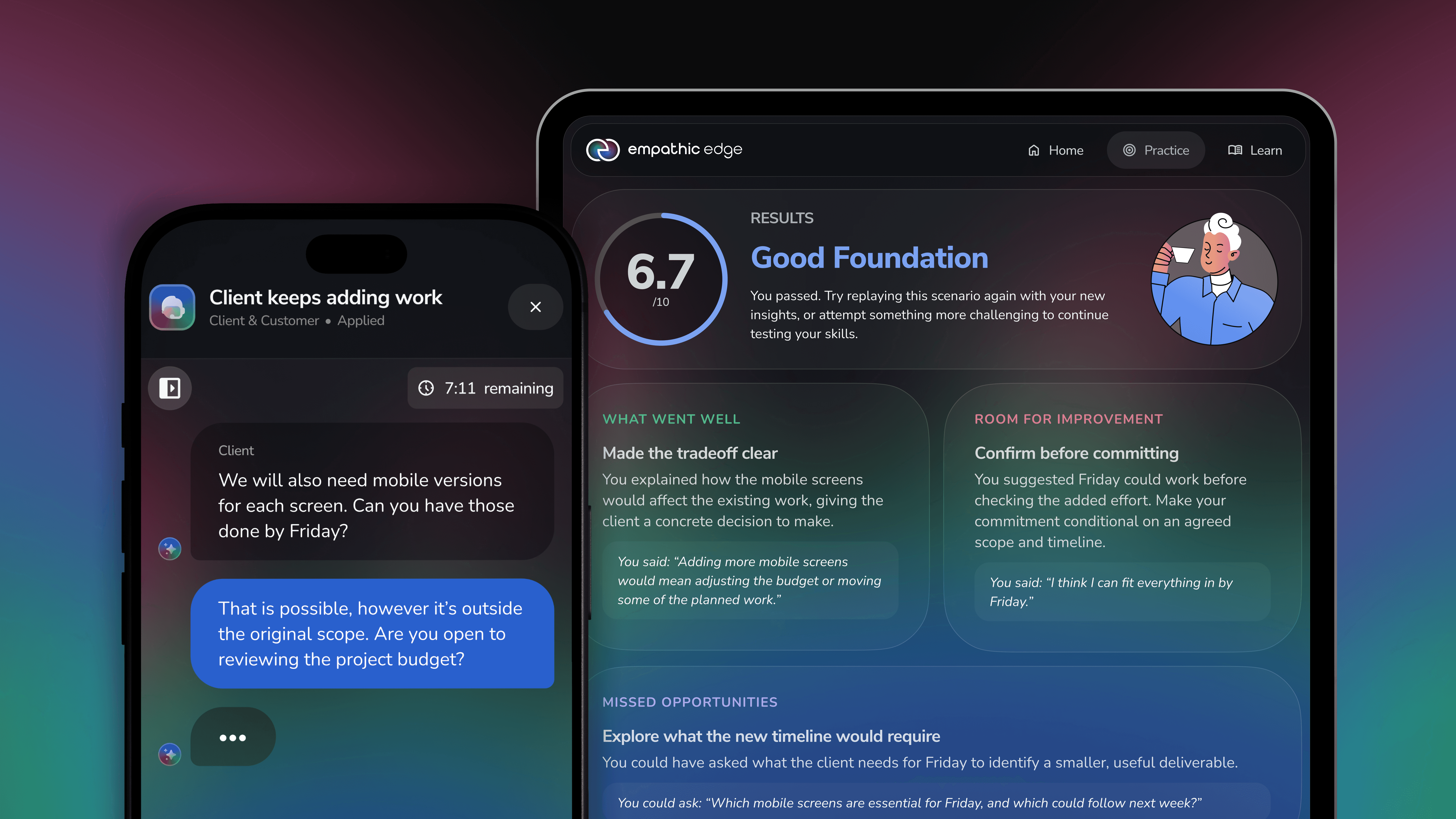
Empathic Edge helps learners prepare for high-stakes conversations through realistic roleplays, specific feedback, supporting lessons, and personalized next steps. The final experience connects each activity so learners can find relevant practice, understand their performance, and continue building their skills over time.
A connected experience designed around practice, reflection, and continued learning.
Find relevant practice
Browse conversations by context, skill, and complexity, or start with a personalized suggestion.
Create a scenario around an upcoming conversation, with the people, context, and stakes that matter.

Repeatable practice, with guidance when you need it
Rehearse a conversation with a realistic AI counterpart and consult the AI Mentor without leaving the experience.

Turn each conversation into something you can learn from
Feedback connects skill observations with moments from the transcript, practical guidance, and clear options for what to do next.

Follow a next step, shaped by your progress
Suggestions draw from learner goals, completed activities, and performance to recommend relevant practice and supporting lessons.

See how practice connects over time
Suggestions draw from learner goals, completed activities, and performance to recommend relevant practice and supporting lessons.


Learn a strategy, then apply it in practice
Short lessons turn negotiation and conflict concepts into practical approaches learners can apply in their next conversation. Learners can explore content by skill or concept, save useful activities, and receive recommendations based on their goals and feedback.

Results
A connected product, now learning from real use.
Empathic Edge is live and continues to evolve through research and design partnerships. The product now connects realistic roleplays, custom scenarios, feedback, lessons, an AI Mentor, and personalized recommendations within one learning experience.
Early post-use research of V2 provided encouraging signals. Of 14 respondents, 12 said the feedback felt credible, 12 felt more prepared after practicing, and 11 said they would use the product independently, with the remaining three responding “maybe.” These findings supported the product’s perceived value, while stopping short of proving long-term skill development.
Ongoing design partnerships are now helping us study how learners discover relevant practice, whether personalized guidance encourages them to return, and how repeated use affects confidence and skill development over time.
A connected experience
LIVE
With realistic AI roleplays, a large scenario library, supporting micro-lessons and personalized recommendation, Empathic edge is currently available for learners to practice their next difficult conversation.
Early evidence of value
VALIDATED
Post-use research indicated strong confidence in the feedback and increased perceived preparedness after practice.
Design partnerships
ONGOING
We are engaging in active design partnerships, using live engagement and feedback to inform iteration in real-time.
Evidence of skill development
NEXT
Next up to evaluate skill development with repeat practice and ongoing usage.
Reflection
The product’s value comes from connecting the experiences around the AI.
The most important shift during this project was moving beyond isolated roleplay sessions. We knew AI made repeatable practice possible, but figuring out how to connect the surrounding structure made it useful, connecting: relevant scenarios, evidence-based feedback, supporting lessons, and clear next steps.
My central contribution was connecting research, product strategy, content architecture, UX and interaction design into that broader system. The project reinforced that personalization requires more than just giving user's access to content and hoping they make something of it information. It depends on a shared structure that can translate the learner's goals and performance into guidance they can understand and use.
Other project details
Organization
Empathic Edge LLC
Sector
Education
Tools Used
Figma
FigJam
Google Drive
Notion
Adobe Illustrator
Adobe Premire Pro
Replit
Responsibilities
Discovery
Market Research
Competitive Analysis
User Research Strategy & Facilitation
User Need Validation
Requirements Definition
Systems Design
Stakeholder Management
Project Management
UI Design
UX Architecture
Metric Tracking (post-launch)
Branding
Engineering Collaboration
QA Testing
